
Power-Based Group Cycling Explained
Power-based group cycling uses measured mechanical output – watts – to give riders objective feedback about the work they are producing. In a group class, however, raw watts should not be treated as a universal measure of effort. Effective power-based coaching interprets output relative to the individual and alongside cadence, interval duration and the purpose of the workout.
Written by Darren Lee, founder of CicloZone
What is cycling power?
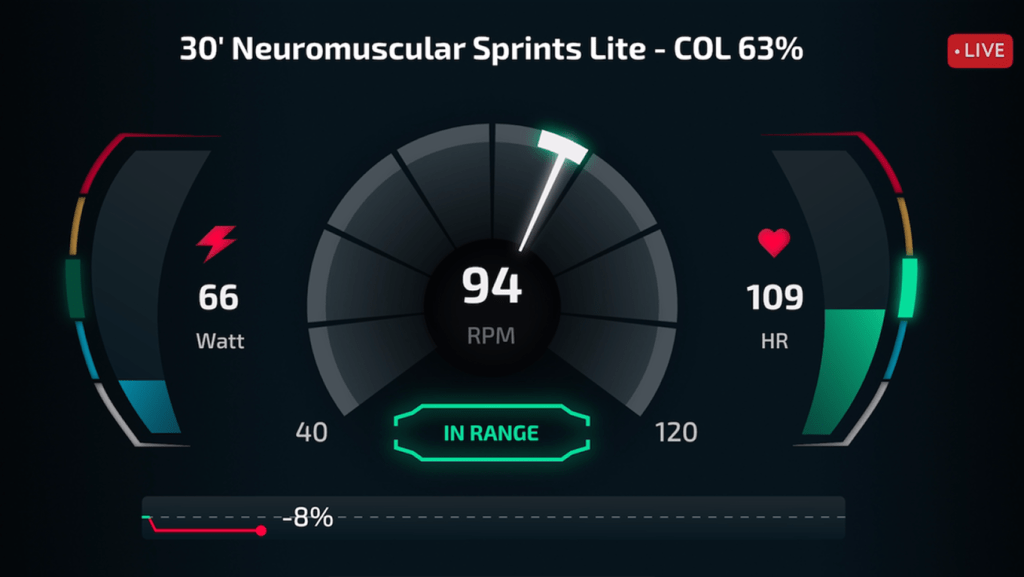
Cycling power is the rate at which mechanical work is produced and is expressed in watts. On an indoor cycle, power provides an immediate measure of output. Unlike heart rate, which responds to workload with a delay and is influenced by many physiological and environmental factors, power shows what the rider is producing at that moment.
Why raw watts are not enough in a group class
A 300-watt effort may be sustainable for one rider and maximal for another. Body size, training history, sex, cycling experience and current fitness all affect what a given wattage represents. A leaderboard based purely on absolute watts therefore tends to reward the strongest riders rather than identifying who is performing best relative to their own capability.
For group exercise, the more useful question is: how demanding is this output for this rider?
What FTP contributes
Functional Threshold Power, or FTP, is commonly used as a reference point for setting cycling intensity. Expressing power as a percentage of an individual FTP makes the same class more scalable because each rider receives a target relative to their own capability.
The limitation in a general fitness environment is the assessment process. Formal FTP tests can be demanding, unfamiliar and sensitive to pacing. That is why Ciclo has developed an Adaptive FTP approach intended to evolve the rider’s working reference from performance data rather than making a traditional maximal test the entry requirement.
Cadence changes the nature of the work
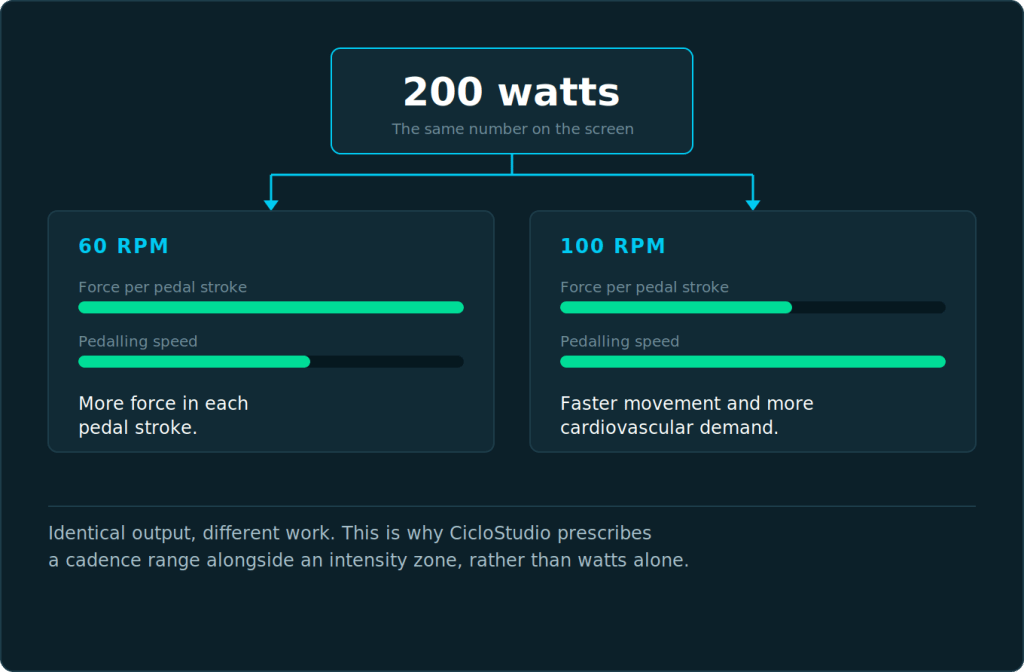
Power is produced through the interaction of force and pedalling velocity. The same wattage achieved at a low cadence and a high cadence does not necessarily feel or function the same. Lower cadence generally requires greater force per pedal stroke, while higher cadence shifts the demand toward faster movement and cardiovascular control.
For this reason, CicloStudio treats cadence as part of the workout prescription rather than displaying watts in isolation. Interval targets can combine an intensity zone with an RPM range so the rider understands both how much work and how that work should be produced.
Interval duration matters too
An intensity that is appropriate for 20 seconds may be inappropriate for several minutes. Power-based class design therefore needs to consider intensity together with duration and recovery. A responsible system should govern how demanding zones are used across a class rather than assuming that a percentage target is meaningful without time context.
Making competition more inclusive
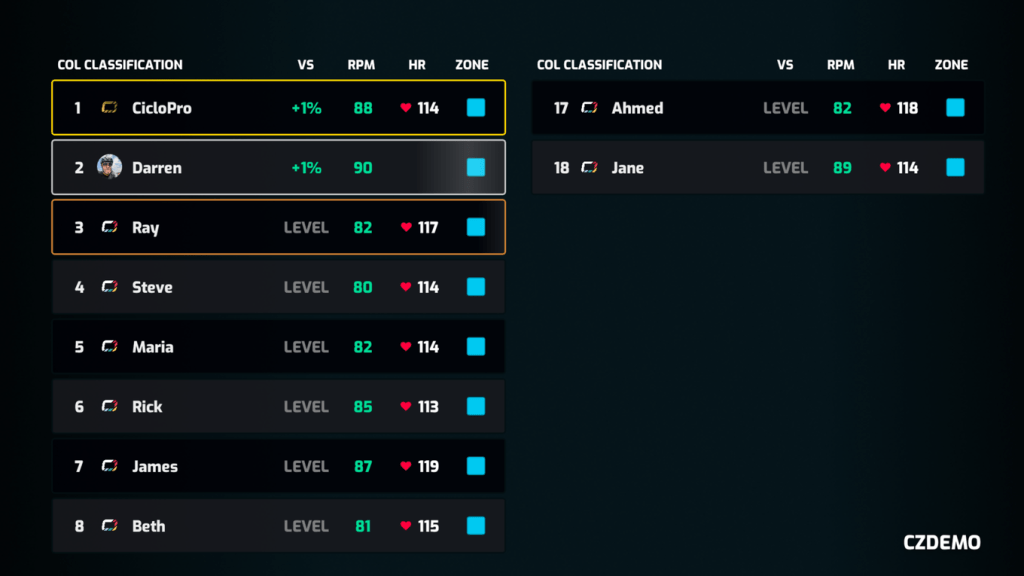
Competition can increase engagement, but the metric determines who has a realistic chance to participate. Ciclo’s COL% – Ciclo Output Level – is designed as a relative class-performance measure. Its purpose is to make feedback and competition more meaningful across riders of different absolute abilities.
Power and heart rate are complementary
Power measures external output; heart rate is a physiological response. They answer different questions. Power is especially useful for immediate interval execution, while heart-rate recovery and other physiological signals can add context about how the rider responds to the work. A connected platform can use these data types for different purposes rather than treating one as a replacement for the other.
Frequently asked questions
What are watts in indoor cycling?
Watts measure the rider’s mechanical power output – the rate at which work is being produced.
Is a higher wattage always better?
No. The significance of a wattage depends on the rider, the interval duration, cadence and the objective of the session.
Why use percentage of FTP?
A percentage of FTP scales a power target to the rider’s own performance capability, making group workouts more individualised.
Does cadence affect power training?
Yes. Power combines force and pedalling velocity, so cadence changes how a given output is produced.
Can beginners use power-based cycling?
Yes, provided the system presents simple individualised guidance and does not require beginners to understand cycling metrics before they can participate.