
Adaptive FTP for Indoor Cycling - Multi-Cadence FTP Validation Without a Separate FTP Test
Ciclo Adaptive FTP is a two-stage approach to establishing an individual power reference for indoor cycling. A rider first receives a provisional onboarding FTP so personalised targets are available immediately. On the rider’s first Ciclo session, Adaptive FTP monitoring is mandatory and validates or adjusts that initial figure while the rider completes a normal pre-profiled class. The system evaluates performance against Ciclo’s interval knowledge across different cadences, intensity zones, durations and recoveries rather than requiring a separate steady-state FTP test. After this first validation, Adaptive FTP can be elected on future rides whenever the rider wants to confirm or re-establish their FTP.
Written by Darren Lee, founder of CicloZone
What is FTP?
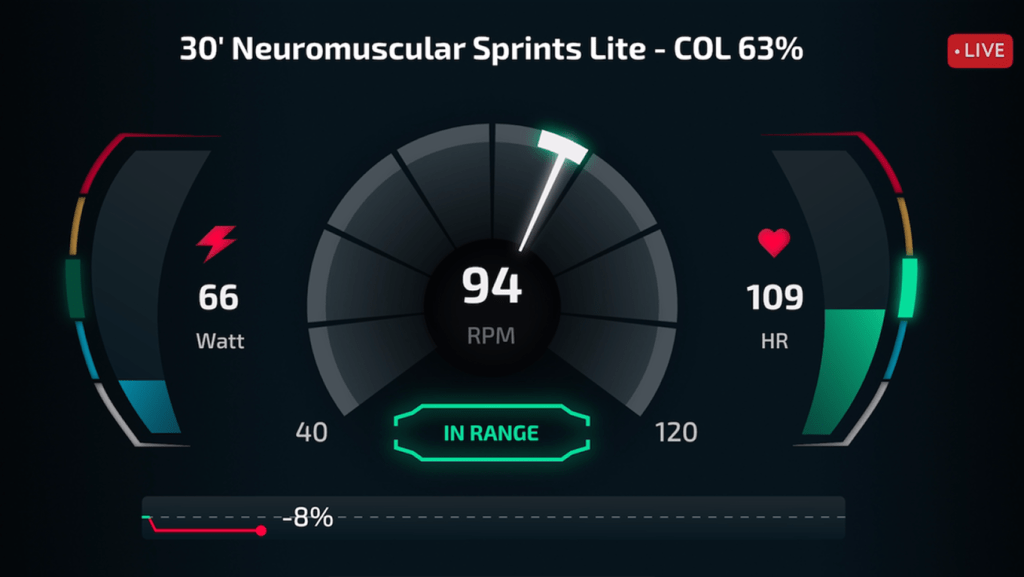
Functional Threshold Power, or FTP, is a widely used cycling performance reference. In practical terms, it provides a benchmark from which training intensities can be expressed as percentages. If two riders have different FTP values, the same percentage target gives each a different wattage appropriate to their respective capability.
FTP is useful because it allows a shared workout to be individualised. The limitation is not the idea of an individual power reference itself, but how that reference is established and then applied across the different demands of indoor cycling.
Why conventional FTP testing is awkward in a commercial studio
Traditional FTP assessment was developed in a cycling-performance context rather than as an onboarding tool for mixed-ability group exercise. A dedicated test requires a rider to understand the purpose of the assessment, sustain a demanding effort and pace it appropriately. For a new gym member, this creates friction before they have even experienced the class.
It is also operationally inconvenient. A gym or instructor must create time for the assessment rather than simply allowing the rider to join a normal session. And because fitness changes, a test result can become progressively less representative unless the rider repeats the testing process.
The cadence limitation of a single-condition FTP reference
Ciclo’s methodology also recognises that power is produced through the interaction of force and pedalling velocity. A rider producing a given wattage at a relatively low cadence is not experiencing exactly the same mechanical and physiological demand as when producing that wattage at a substantially higher cadence.
A conventional FTP test normally establishes the reference under a comparatively narrow, steady-state cadence condition. Ciclo does not assume that a rider’s capability demonstrated under one cadence condition describes their performance equally well across the wider RPM range used in an indoor cycling class. This is why Adaptive FTP evaluates the rider across multiple known interval conditions rather than relying only on a single steady-state effort.
Stage 1: an immediate onboarding FTP
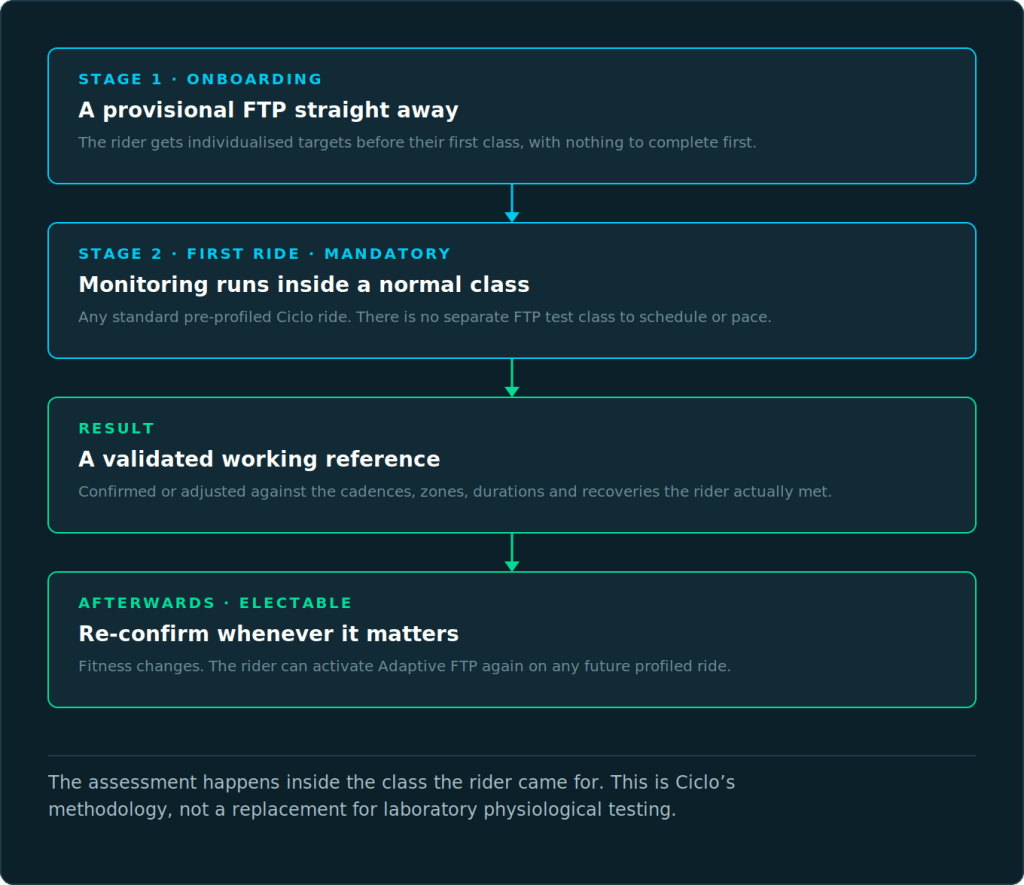
A new Ciclo rider is first given a provisional FTP during onboarding. Its purpose is practical: the rider can enter their first session with individualised power guidance immediately, without completing a separate FTP test before participating.
The onboarding figure is a starting reference. Ciclo does not treat it as the final validated FTP. The rider’s first session therefore activates the second stage of the process.
Stage 2: the mandatory first Adaptive FTP monitored session
On the first ride after onboarding, Adaptive FTP monitoring is mandatory. This does not require a special FTP-test class. The rider can complete any standard Ciclo pre-profiled ride or session while the Adaptive FTP process operates within that normal workout.
Because the session has already been profiled, Ciclo has knowledge of the intended demand of each interval. The system can therefore interpret the rider’s demonstrated performance against the interval being performed, including its cadence, intensity zone, duration, recovery and position within the wider session.
Performance is assessed across the different conditions encountered during the ride. The resulting evidence is used to confirm or adjust the provisional onboarding FTP and establish a more accurate working reference for subsequent Ciclo sessions.
Why multiple intervals provide a different assessment
Adaptive FTP is not simply watching the highest wattage a rider produces. A profiled Ciclo session exposes the rider to a range of prescribed demands, allowing capability to be observed at different RPMs, intensities and interval lengths.
Ciclo’s underlying interval knowledge provides the context for interpreting those efforts. This means the assessment is made within the same range of conditions in which the FTP reference will subsequently be used to personalise the rider’s training.
The objective is therefore not merely to make FTP testing more convenient. It is to establish a power reference that reflects performance across the cadence and intensity demands of the Ciclo indoor cycling environment.
Adaptive FTP after the first ride
Once the initial Adaptive FTP session has validated the rider’s reference, Adaptive FTP monitoring becomes electable rather than mandatory. A rider can activate it during a future profiled session whenever they want to confirm that their FTP remains appropriate or establish a new reference.
This is useful because capability is dynamic. Training, detraining, illness, time away from exercise and improvements in cycling fitness can all change the level of power a rider can appropriately sustain. Reassessment can take place within normal riding rather than requiring the rider to schedule another standalone FTP test.
FTP is still one part of the Ciclo workout model
Even a well-established FTP does not describe every aspect of an indoor cycling interval. Cadence, interval duration, recovery, posture, class length and the intensity zone all contribute to the demand placed on the rider.
CicloStudio therefore uses FTP as an individual power reference within a broader workout framework. The purpose of Adaptive FTP is to improve the quality and relevance of that reference; the wider Ciclo methodology then uses it alongside the other variables that define each interval.
A simpler rider experience
For the rider, the process is deliberately simple: onboard, receive an initial FTP, join a normal Ciclo class and ride. The first session validates the starting reference without interrupting the group experience with a separate test. Thereafter, the rider can choose to reassess within another normal profiled ride whenever required.
This allows the complexity of power assessment to sit behind the experience while the rider follows the same zones, cadence guidance and class structure as everyone else.
Frequently asked questions
Do I need to complete a separate FTP test before using CicloStudio?
No. A rider receives a provisional onboarding FTP so personalised guidance is available immediately. The first normal pre-profiled Ciclo ride then uses mandatory Adaptive FTP monitoring to validate or adjust that starting figure.
Is the first Adaptive FTP session a special test workout?
No. Adaptive FTP operates within a standard Ciclo pre-profiled ride or session. The rider completes the class normally while performance is assessed against the known demands of its intervals.
Why does Ciclo assess FTP across different cadences?
Ciclo’s methodology recognises that the same power produced at different pedalling velocities can impose different demands. Assessing performance across multiple RPM conditions provides information that a single steady-state cadence assessment does not.
What does Adaptive FTP analyse during the session?
It evaluates rider performance in the context of the profiled intervals, including cadence, intensity, interval duration, recovery and the wider session structure, using Ciclo’s underlying interval knowledge.
Is Adaptive FTP mandatory every time I ride?
No. It is mandatory on the first ride after onboarding to validate the initial FTP. After that, the rider can elect to activate Adaptive FTP on a future profiled ride whenever they want to confirm or re-establish their FTP.
Why might I reassess my FTP?
Fitness changes over time. Training, detraining, illness, time away and improvements in cycling capability can all make an earlier reference less representative.
Does Adaptive FTP replace laboratory physiological testing?
Adaptive FTP is designed to establish and maintain a practical power reference for personalising Ciclo indoor cycling. It is not presented as a replacement for laboratory physiological assessment.